




Hey there! As a supplier of Syringe Filter MCE, I often get asked about what exactly the material of Syringe Filter MCE is. So, I thought I'd take some time to break it down for you in this blog post.
What is MCE?
MCE stands for Mixed Cellulose Esters. It's a blend of cellulose acetate and cellulose nitrate. This combination gives MCE some pretty cool properties that make it a great material for syringe filters.
Cellulose acetate is known for its good chemical resistance. It can handle a wide range of solvents and aqueous solutions without breaking down easily. This means that when you're filtering different types of samples, the filter won't get damaged by the chemicals in the solution.

Cellulose nitrate, on the other hand, has excellent protein binding properties. It can trap proteins and other large molecules effectively, which is super useful when you're trying to purify a sample. When these two are combined to form MCE, you get a material that's both chemically stable and great at filtering out unwanted particles.
Why Use MCE in Syringe Filters?
One of the main reasons MCE is used in syringe filters is its high porosity. The pores in MCE filters are uniform in size, which allows for consistent filtration. Whether you're filtering a small volume of a precious sample or a larger quantity of a solution, you can expect the same level of filtration efficiency.
Another advantage is its transparency. MCE filters are clear, which makes it easy to visually inspect the filtration process. You can see if there are any clogs or if the sample is passing through the filter as expected. This transparency also comes in handy when you need to perform some post - filtration analysis on the filter itself.
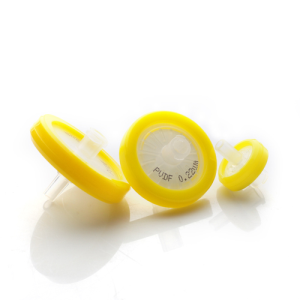
MCE filters are also very flexible. They can be easily cut and shaped to fit different syringe filter designs. This flexibility allows for the production of a wide variety of syringe filters, such as the 33mm Syringe Filter, Syringe Wheel Filter, and 30mm Syringe Filter.
Applications of Syringe Filter MCE
Syringe Filter MCE has a ton of applications in different fields. In the pharmaceutical industry, it's used to filter drugs and injectables. This ensures that the final product is free from any contaminants or particles that could be harmful to patients.
In the food and beverage industry, MCE filters are used to clarify liquids. For example, they can be used to remove sediment from wine or to filter fruit juices to make them clearer.
In the environmental field, these filters are used to analyze water samples. They can trap pollutants and particles in water, allowing scientists to study the quality of the water and identify any potential contaminants.
Manufacturing Process of Syringe Filter MCE
The manufacturing of Syringe Filter MCE starts with the preparation of the MCE solution. The cellulose acetate and cellulose nitrate are dissolved in a suitable solvent to form a homogeneous solution. This solution is then cast onto a flat surface to form a thin film.
After the film is formed, it goes through a phase - inversion process. This process creates the pores in the MCE film. The size of the pores can be controlled by adjusting the manufacturing parameters, such as the concentration of the solution and the temperature during the phase - inversion process.
Once the MCE film is ready, it's cut into the appropriate size and shape and then assembled into the syringe filter housing. The housing is usually made of a plastic material, such as polypropylene, which is also chemically resistant and compatible with the MCE filter.
Quality Control of Syringe Filter MCE
As a supplier, we take quality control very seriously. Before our Syringe Filter MCE products are shipped out, they go through a series of tests. First, the pore size of the filter is measured using a specialized instrument. This ensures that the filter meets the specified pore size requirements.
We also test the filtration efficiency of the filters. We use a standard test solution with a known concentration of particles and measure how many particles are removed by the filter. This gives us an idea of how well the filter is performing.
In addition, we test the chemical compatibility of the filters. We expose the filters to different chemicals and solvents to make sure they don't break down or react with the substances they're supposed to filter.
Comparing MCE with Other Filter Materials
There are other materials used in syringe filters, such as polyethersulfone (PES) and nylon. Compared to PES, MCE has better protein binding properties. PES is more suitable for applications where you need to filter samples with a high protein content without binding too much of the protein.
Nylon filters are more hydrophobic than MCE filters. This means that nylon filters are better at filtering non - aqueous solutions, while MCE filters are more commonly used for aqueous solutions.
Conclusion
So, there you have it! That's what the material of Syringe Filter MCE is all about. MCE, a blend of cellulose acetate and cellulose nitrate, offers a unique combination of chemical resistance, high porosity, and good protein binding properties. It's widely used in various industries for different filtration applications.
If you're in the market for high - quality Syringe Filter MCE products, we're here to help. Whether you need the 33mm Syringe Filter, Syringe Wheel Filter, or 30mm Syringe Filter, we've got you covered. Feel free to reach out to us to discuss your specific requirements and start the procurement process.
References
- "Cellulose Esters: Chemistry and Applications" by James F. Kennedy
- "Filtration Technology in the Pharmaceutical Industry" by Peter A. Williams